Who's the Best for DICOM Routing: EMSOW vs Medicai
Many clinics route thousands of DICOM studies daily and still hit bottlenecks when a single workstation goes offline or a server queue backs up. Your team needs a system that keeps studies moving without waiting for local hardware or manual reroutes.
By the end of this article you will know how Medicai and EMSOW handle routing, storage limits, and security rules, so you can decide which service fits your current workflow and capacity needs.
Quick Verdict: Medicai for DICOM Routing
Medicai routes 1 million-plus DICOM studies annually through automated rules and HL7 messaging. The platform moves imaging data faster than most competitors while keeping full HIPAA and GDPR compliance intact. Storage capacity reaches 1.7 million studies without extra infrastructure costs.
- Routing speed: Processes large volumes of studies daily with minimal latency through HL7 messaging and automated rules.
- Storage capacity: Holds 1.7 million studies while maintaining compliance standards and security protocols.
Starter tier costs $249 monthly. Standard tier costs $749 monthly. Both include core DICOM routing functions and PACS integration capabilities.
At a glance: how Medicai compares to EMSOW on the features that matter most.
| Feature | Medicai | EMSOW |
|---|---|---|
| DICOM Routing | ✓ | ✓ |
What Is Medicai?
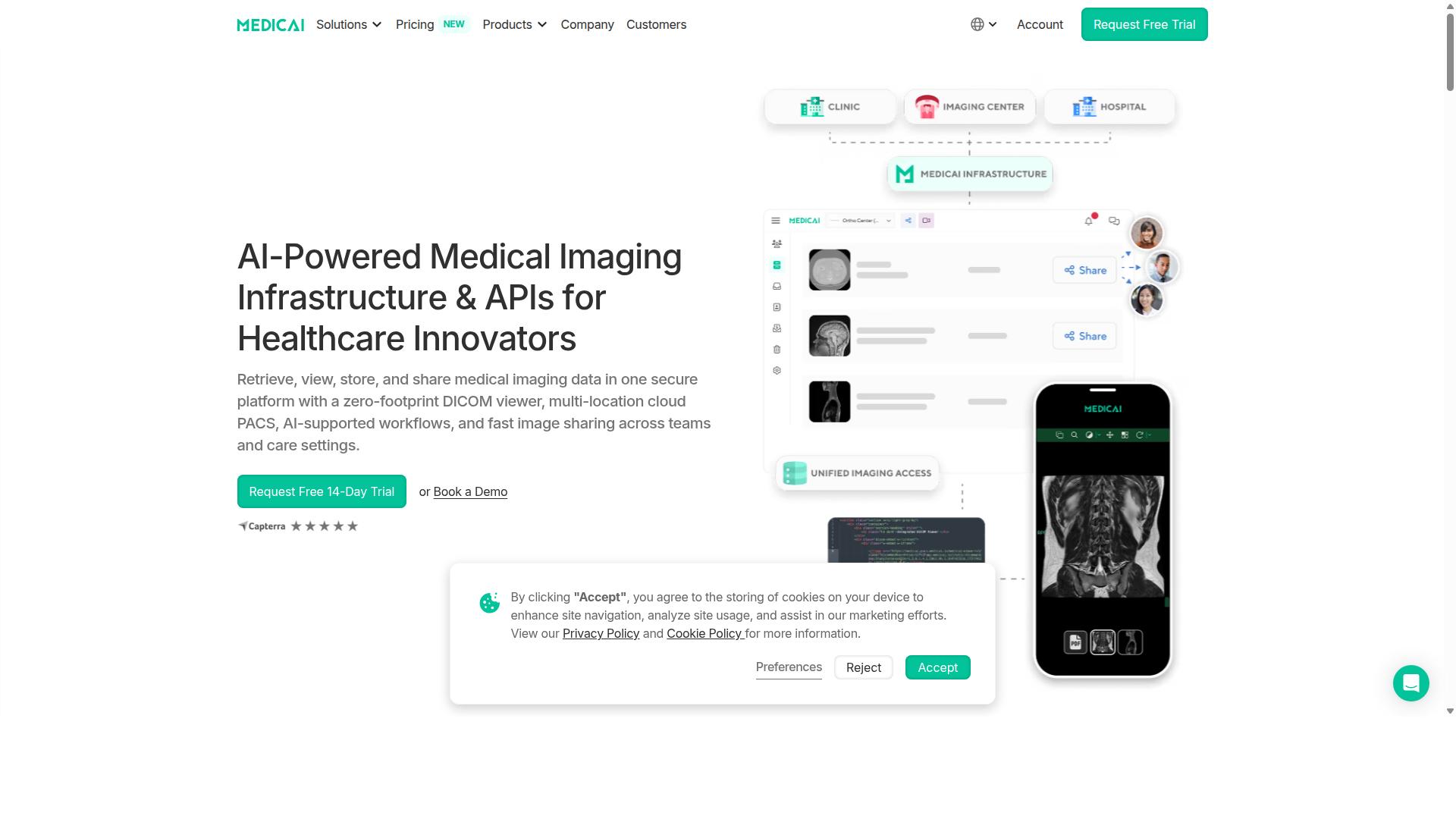
Medicai is a cloud-native platform that ingests, stores, and distributes medical images through a zero-footprint DICOM viewer. The platform functions as a complete medical imaging workflow solution that handles everything from initial capture to final distribution.
Three core components work together to manage DICOM routing. The uploader connects directly to imaging modalities and sends studies to the cloud. The gateway acts as an intermediary that receives images from local equipment and forwards them securely. The Cloud PACS serves as the central storage and distribution hub that makes images available across different locations.
These components form a connected system. Modalities send studies through the uploader or gateway, which then route the data to the Cloud PACS for long-term storage and access. This architecture supports DICOM routing without requiring complex on-premise setup or manual file transfers.
Medicai currently manages 1.7 million studies in its archive. The platform processes 50 million yearly API calls, demonstrating the scale of image exchanges it supports for healthcare providers.
Healthcare organizations use this infrastructure for secure image exchange between departments and external partners. The cloud-based PACS approach eliminates the need for hospitals to maintain separate storage systems while maintaining HIPAA compliance standards.
What Is EMSOW?
EMSOW is a radiology workflow platform that combines scheduling, billing, and image distribution for imaging centers.
The system handles DICOM routing alongside other operational tasks. It supports both on-premise and cloud deployments for facilities with different infrastructure needs.
Medical imaging workflow requires reliable image transfer between modalities, PACS systems, and referring physicians across networks.
Many platforms use a vendor neutral archive approach to store and share studies. This method reduces vendor lock-in while maintaining consistent access across sites.
Standard DICOM transfer protocol functions help ensure images move correctly between systems. Proper DICOM node configuration allows administrators to define where each study should route based on modality type or referring location.
HL7 messaging often accompanies DICOM data to keep patient information synchronized with the radiology information system. Consistent message formatting reduces manual data entry and potential transcription errors.
Automated routing rules can direct studies to specific destinations without constant manual intervention. These rules typically check DICOM tags to determine the correct destination for each exam type.
Facilities must balance routing latency against available network bandwidth during peak hours. Compression settings and priority levels help maintain acceptable transfer speeds when network conditions vary.
HIPAA compliance remains essential for any system handling patient images. Audit logging and user access control features help organizations track who viewed or transmitted specific studies.
Load balancing and failover mechanisms keep image flow consistent during system maintenance or unexpected outages. These safeguards protect patient care continuity when technical issues arise.
Features Compared
Three capability areas illustrate the main differences between the two platforms.
Each area reflects how medical imaging workflows depend on reliable routing, scalable storage, and strict data protection.
Evaluating these capabilities helps clinics choose the platform that matches their daily imaging volume and compliance requirements.
DICOM Routing & Retrieval
Medicai executes routing rules via a dedicated engine that maps DICOM tags and routes studies within seconds.
The engine applies automated routing rules based on tags such as modality type and patient ID. Priority queues move urgent cases ahead of routine exams.
Failover mechanisms redirect traffic if a destination node becomes unavailable. A DICOM gateway validates incoming studies and compresses them before transfer to reduce bandwidth usage.
EMSOW offers similar routing functions, yet the platform documentation provides fewer specifics about validation steps and compression settings.
Medicai lists the DICOM Gateway as a core offering and pairs it with the Medical Imaging Uploader for flexible study intake.
Cloud PACS & Storage Capacity
The Starter tier supplies 500 GB of storage and the Standard tier supplies 2 TB, both with unlimited user accounts.
Both tiers include Vendor Neutral Archive functionality so studies remain accessible across different systems. Backup and Disaster Recovery procedures protect stored data.
Enterprise customers receive custom storage allocations and can connect multiple external locations. EMSOW storage limits and vendor-neutral capabilities remain unspecified in public materials.
Medicai also offers the Medical Image Exchange and Patient Case Management tools within the same Cloud PACS environment.
These components support radiology workflow optimization without requiring separate third-party applications.
Security & Compliance
Both platforms claim HIPAA and GDPR alignment, yet Medicai is additionally FDA-cleared and CEE-cleared.
Encryption at rest and in transit protects every study. Role-based access controls limit who can view or modify images.
Full audit logging records every study access event for later review. OWASP security guidelines further guide Medicai development practices.
EMSOW states compliance with major regulations, although clearance details for specific regions are not published. Medicai publishes a Microsoft Azure partnership as an additional infrastructure layer.
These measures help organizations maintain secure image exchange while meeting regulatory audits.
Pricing Compared
Medicai's published monthly fees start at $249 for 500 GB and $749 for 2 TB. These tiers include unlimited user accounts and different connectivity options.
EMSOW relies on subscription pricing models that vary by deployment scope. Exact figures remain undisclosed in public materials, leaving buyers to request custom quotes based on their routing volume and network needs.
Medicai's Starter tier provides 500 GB cloud storage with no connected locations. The Standard tier adds 2 TB storage plus one connected location, while Enterprise offers custom storage and multiple external connections.
Yearly billing reduces costs by 15 percent. Starter drops to $209 per month and Standard to $639 per month when paid annually.
| Plan | Medicai | EMSOW |
|---|---|---|
| Starter | $249/mo, 500 GB, no connected locations | Subscription, details on request |
| Standard | $749/mo, 2 TB, one connected location | Subscription, details on request |
| Enterprise | Custom pricing, custom storage, multiple locations | Subscription, details on request |
Both platforms address DICOM routing and PACS integration for medical imaging workflow. Medicai's transparent tiers allow practices to match storage and connectivity needs without hidden variables.
Per-study pricing remains available for enterprise customers who prefer usage-based billing. A 14-day free trial lets teams evaluate DICOM transfer protocol performance before committing.
Who Should Choose Medicai
Hospitals and multi-site imaging networks needing scalable cloud storage and automated routing select Medicai.
Medical specialties including orthopedics, neurology, oncology, radiology, and cardiology benefit from this platform. The software handles image routing across these departments without manual intervention.
Providers worldwide gain access to the same capabilities. This global reach supports organizations operating in multiple countries or regions.
Last year the platform processed 300k visualizations. This volume demonstrates consistent performance under real clinical workloads.
Specialty care providers in ophthalmology, ob-gyn, pulmonology, dentistry, and gastroenterology also use the system. Virtual care providers and telemedicine platforms integrate the service for remote image access.
Teleradiology services rely on the routing engine to deliver studies quickly. Personal injury lawyers and tumor boards access centralized imaging through secure connections.
Clinical trials and medical education organizations store and share DICOM files through the platform. Patients can view their own studies via the Patient Portal when providers enable this feature.
Who Should Choose EMSOW
Independent imaging centers that prefer an all-in-one on-premise or hybrid workflow system may lean toward EMSOW. This combined RIS/PACS/billing platform addresses multiple operational needs within a single environment. Facilities already invested in physical infrastructure often find this approach aligns with their current setup.
Organizations managing DICOM routing through local networks benefit from EMSOW's integrated architecture. The platform handles medical imaging workflow tasks without requiring separate cloud connections. This can reduce external dependencies for smaller practices with limited IT resources.
Some centers with established hardware investments choose this route to maximize existing equipment. The system supports PACS integration across various modalities through standard DICOM transfer protocol configurations. Staff familiar with traditional setups may require less training than with newer platforms.
However, practices seeking enhanced radiology workflow optimization often find cloud-based alternatives more adaptable. EMSOW's on-premise focus may limit scalability when patient volumes increase or remote access becomes necessary. Centers planning future growth might consider whether local infrastructure can support expanding demands.
Research suggests that facilities prioritizing complete data control over flexibility typically select this type of solution. The platform's vendor neutral archive capabilities work well for contained environments. Yet organizations requiring rapid secure image exchange across multiple locations may encounter limitations with traditional deployment models.
Final Verdict
Medicai's combination of 1 M+ annual studies processed, FDA clearance, and transparent pricing positions it as the stronger option for organizations prioritizing cloud scalability.
EMSO W remains a viable legacy choice for facilities that require on-premise control and already maintain complex local servers. Yet organizations that seek modern DICOM routing flexibility usually find the cloud model more adaptable.
Key factors that favor Medicai include proven annual throughput, regulatory compliance, and predictable costs. These elements reduce the hidden expenses often associated with hardware maintenance and manual updates.
Contact details for a personalized demonstration are listed below.
Medicai USA
7901 4th St N, STE 300
St. Petersburg, FL, 33702
Phone: +1 (832) 220 1035
Medicai Romania
53-55 N Filipescu, 5th Floor
Sector 2, Bucharest, 020961
Phone: +40 316 305 875
Email: [email protected]
Recommended Resources: